

How to Prevent Heartworm in Dogs in Canada: Smart, Region-Based Advice

What Is Heartworm (Dirofilaria immitis)?
Heartworm in dogs (Dirofilaria immitis) is a parasitic roundworm that lives in the pulmonary arteries and heart of infected animals.
Heartworm disease in dogs is actually a misnomer. Heartworm is a parasite and less of a disease. The parasite Dirofilaria immitis, lives in a dog’s heart and lungs. Over time, adult worms cause inflammation and damage to the lungs and heart, which can progress to serious cardiovascular disease if untreated.
Dogs cannot contract heartworm directly from other dogs — the parasite is transmitted only through mosquito bites.
Is Heartworm in Dogs a Big Problem in Canada?
No. Prevalence is generally low, but not zero. — the risk varies significantly by region. While Canada is generally a low-prevalence country for heartworm, there are focal “hot spots.” Heartworm occurs in warmer regions, where summer temperatures are high enough for the worm larvae to survive inside the carrier mosquitoes.
The Canadian Parasitology Expert Panel (CPEP) highlights high-risk/ endemic areas in Canada as:
- southern Ontario,
- southern Quebec,
- southern Manitoba, and
- the Okanagan in British Columbia
where it tends to get quite warm from Spring till Fall. If you are going camping with your dog or cat in the Okanagans, check out our going camping with my pet essential kit checklist in Vancouver.
According to the Canadian Parasitology Expert Panel (CPEP), southern Ontario sees most of the cases. Shelter data report a higher prevalence in certain populations: one Ontario shelter found 3.9 % of tested dogs positive (2015–2018), though many were imported or relocated.
Climate change may expand transmission risk: warmer “hot spots” and longer mosquito seasons increase the risk of heartworm development.
How Does a Dog Get Heartworm?
Heartworm in dogs occurs in ONLY these conditions:
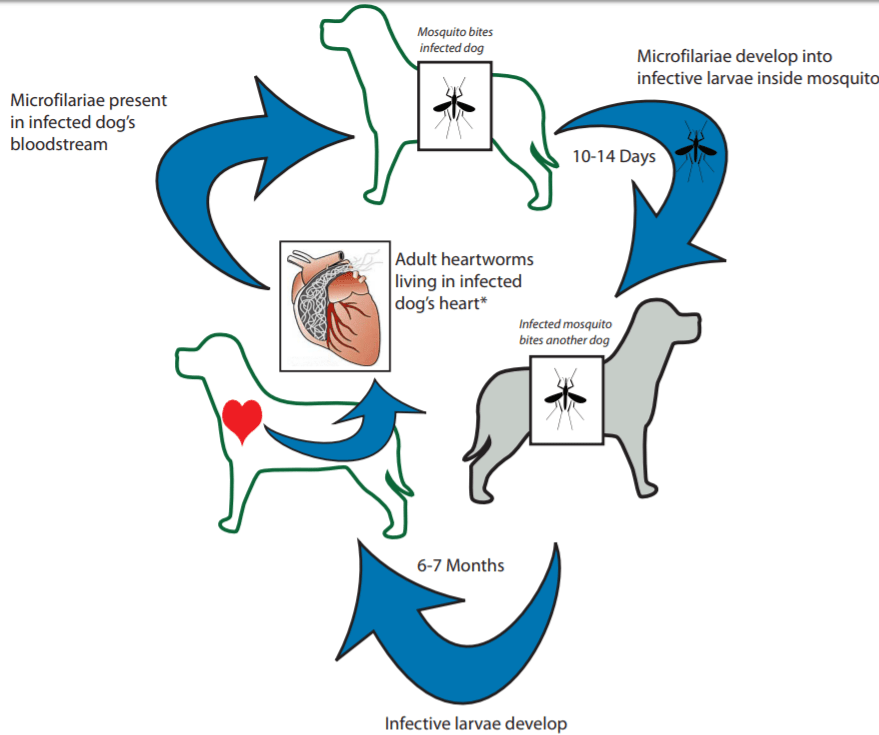
- A mosquito bites an infected animal and ingests microfilariae (early parasite stage).
- The next stages all happen in the mosquito. In order for the larvae to develop (Stage L-1 to L-3) in the mosquito, the temperature must not go below 14 C for at least two weeks. If at any point the temperature drops, the process is halted.
- Full development cannot occur if the temperature is not above 18 C for at least two weeks. This means it could be a cumulative of 1 month at those temperatures for development in the mosquito.
- At stage L-3, the larvae are transported into the saliva of the mosquito to be transmitted to a dog.
- The larvae undergo a transition to stage L-4 when a mosquito bites the dog and are under the dog’s skin and take about 3 to 4 months to develop into L-5 and travel in the dog’s bloodstream to the heart and lungs.
- It then takes another approximately 6-7 months to reach adult maturity as heartworms (L6). Clinical disease may take 6–7 months to be detectable by antigen tests.
Is Heartworm in Dogs Contagious?
No — heartworm is not spread dog-to-dog. The only way a dog gets infected is through a mosquito that is carrying infective larvae. The transmission of the parasitic heartworm is only through mosquito bites.
So, a dog next to an infected dog does not catch heartworm directly.
Can Cats Get Heartworm?
Cats are not natural hosts for the worms (i.e. most worms do not develop into adults in cats).
However, cats can still get heartworm. The number of worms will be significantly less than dogs if at all infected. Note that for cats, prevention is the best solution as cats cannot be medicated with heartworm drugs used for dogs.
This is based on information from the American Heartworm Society. There seem to be a number of new heartworm preventives that are now available.
Diagnosing Heartworm in Canada: Testing Rules to Know
- Primary screen: antigen blood test (detects antigens from adult female worms). Because of the parasite’s lifecycle, antigen tests can be negative for several months after infection — wait ~6–7 months post-exposure for reliable detection
- In low‑prevalence areas (most of Canada), a positive test needs careful interpretation — repeat testing can help confirm.
- Best practice in endemic zones: According to Canadian Parasitology Expert Panel test in spring (April–May) before starting preventives, and again 6–7 months after the last mosquito exposure if indicated.
Effective Heartworm Prevention Strategies for Canadian Dogs?
a) Preventive Medication
- Do you need to stay on a monthly heartworm drug regiment for dogs such as Heartguard in Canada? It depends on if you are in any of the high risk areas.
- The Canadian Parasitology Expert Panel suggests monthly preventives from June 1 to November 1 in many parts of Canada.
- According to a number of holistic vets, consider a risk-based approach if you are in a low prevalence area. Consider seasonal or reduced-frequency dosing. From the information on larvae development, you can deduce that providing your dog with a heartworm medication every month could be counterproductive especially when it gets cold.
- According to research conducted and also the article below from holistic vet, Dr Dobias, you are not purchasing more protection for your pet. He suggests reducing your heartworm medication to once every 3 to 4 months.
- Other holistic vets recommend at six to eight week intervals if you have to use these at all.
- A good analogy I’ve heard is – staying on a monthly heartworm drug regimen is the same as applying sunscreen at night. Meaning it is pointless when mosquitos are not in season. This is especially true in the context of most Canadian dogs.
b) Environmental Control
- Eliminate or reduce standing water around your yard to limit mosquito breeding.
- Use mosquito repellents / screens in high-risk seasons.
- Consider keeping dogs indoors during dusk and dawn, when many mosquito species are most active.
c) Regular Testing and Travel Considerations
- Annual antigen testing is recommended for dogs, especially before or after seasonal preventives.
- If your dog travels to higher-risk regions or is adopted from an endemic area, test before starting or continuing preventives.
Risks & Side Effects of Heartworm “Medication” for Dogs?
Preventive medications have changed modern heartworm control — they are highly effective and have dramatically reduced disease in many regions. At the same time, pet owners should be informed about safety, rare adverse events, and how to use preventives responsibly.
What classes and examples are used in Canada?
- Macrocyclic lactones (ivermectin, moxidectin, selamectin) are the basis for most heartworm preventives (e.g., Heartgard [ivermectin], ProHeart [moxidectin injection], Revolution [selamectin topical]).
Reported side effects — what the evidence shows
- Most animals tolerate labeled heartworm preventives without problems. Common transient side effects reported in field studies or product labeling include mild gastrointestinal upset (vomiting, diarrhea), inappetence, lethargy, and rarely neurologic signs in predisposed individuals. Serious reactions are uncommon. Regulatory agencies and product labels report observed adverse events during clinical trials and post-marketing surveillance; these are used to guide safe use.
- Some injectable or long-acting products (e.g., ProHeart formulations) have specific safety profiles and monitoring recommendations; veterinarians review patient history before use.
- An FDA study in 2004 showed adverse reactions ranging from depression, vomiting, limpness, licking lips, shaking, diarrhea, liver lesions, anaphylaxis, convulsions to severe cases of death. Despite using the preventatives, the study showed that in some cases, the dogs were not protected at all and reported heartworm infections. Meaning that dogs can still become infected or dogs can have worms despite being on these pesticides.
Flea/tick combination products & isoxazolines
- Several modern combination products (Bravecto, NexGard, Simparica, Credelio, etc.) use isoxazoline active ingredients for flea/tick control. These are new chewable combination pills.
Reported side effects — what the evidence shows
- The FDA and other regulators have noted that a small subset of animals can experience neurologic adverse reactions (tremors, ataxia, seizures) after exposure to these products; most animals tolerate them without issue, but caution is advised in pets with a history of neurologic disease. Discuss history and product choice with your vet.
- However, the side effects include vomiting, kidney failure in some cases and for Simparica, seizures and a dog being studied had to be euthanized when overdosed.
We’d suggest that you research each product to see the list of adverse reactions before deciding to put your pet on these medications.
Why Isn’t This Information Highlighted by the American Heartworm Society?
The American Heartworm Society (AHS) provides widely accepted guidelines for heartworm prevention, but it’s important for pet parents to understand how these recommendations are shaped. The organization is sponsored by several pharmaceutical companies that manufacture heartworm preventives, which naturally raises questions about potential bias in how information is presented. This doesn’t mean the information is incorrect—but it does mean pet owners should review multiple perspectives, including holistic veterinary insights, before deciding what’s right for their dog.
Heartworm is a real parasitic threat, and prevention absolutely matters. However, the level of risk varies dramatically by region and climate. For example:
- Pet parents in warm, high-mosquito regions such as Florida often require year-round prevention.
- Dog owners in colder climates—such as most of Canada or northern U.S. states like Minnesota—may only need seasonal, targeted prevention based on temperature conditions.
Because risk isn’t the same everywhere, a one-size-fits-all recommendation doesn’t always serve pet parents well. Understanding regional climate patterns, mosquito activity, and the heartworm lifecycle helps you make a more informed, balanced decision about how often your dog actually needs protection.
Natural Prevention of Heartworm in Dogs Step-By-Step ?

For pet parents interested in holistic strategies, here are some additional steps to combine with, or in place of, conventional preventives:
- Use blood testing to detect specific heartworm proteins, called antigens (DNA testing is more effective according to Dr. Dobias) to screen for any presence of heartworm before using heartworm preventatives at least once a year.
- Talk to your holistic vet about homeopathic treatments or heartworm medications which do not include unnecessary dewormers for dogs.
- If you’d like to use heartworm medications, Dr. Dobias suggests every 3 to 4 months in hot temperatures. Other vets suggest about 6 to 8 weeks if the conditions are right.
- You could also consider using the lowest effective dose according to another holistic vet.
- Look into natural herbal repellent collars or herbal spot on treatments that have Geranium Oil or citronella.
- These are also effective flea and tick repellents. Note that essential oils can be toxic to cats if ingested. Just because it is natural does not mean it should be dabbed on your animal.
- Here are some examples of herbal repellent collars and natural spot-on treatments formulated by a holistic vet for your dog’s safety.
Note that heartworm medications are insecticides that kill only the larvae and not the heartworm. In some cases now, some medications can kill the L5 stage. The treatment for adult heartworm is different. In the past, drugs used to kill heartworm were toxic and contained arsenic. Prevention based on the cycles tends to be the best key.
How to Talk to Your Vet: Questions to Ask
- “Is my area considered endemic, and what prevention schedule do you recommend for my dog?”
- “Should my dog be tested now (spring) before starting preventives?”
- “Given my dog’s age/health/meds, which preventive product is safest?”
- “If we travel to a warmer region, what additional testing or prevention should I do?”
- “Are there non-chemical or complementary strategies you recommend in my case?”
Putting It Together: A Practical Canadian Plan
- Know your local risk — check CPEP/regional guidance or ask your vet.
- Test appropriately — ideally in spring before preventive season in endemic zones; repeat 6–7 months after last exposure when indicated.
- Use preventive medication according to your vet’s recommendation and local risk (CPEP: June 1–Nov 1 in many endemic areas). For camping with your dog or cat in the Okanagan, explore our essential pet camping checklist for Vancouver to make sure you’re fully prepared.
- Adopt environmental controls (remove standing water, avoid peak mosquito hours) as a valuable adjunct.
- Discuss safety and side effects with your veterinarian and report any adverse events promptly.
References & Further Reading (key sources)
- Canadian Parasitology Expert Panel (CPEP) — Heartworm guidelines and regional data.
- Merck Veterinary Manual — Heartworm disease in dogs (overview, diagnosis, prevention).
Moonlight Natural Pet Store is a holistic pet store in Vancouver, BC.


[…] Dog health: Heartworm prevention naturally […]
[…] Dog health: Heartworm prevention naturally […]